Explore Our Methodolgy
This is not traditional HR Consulting for companies that want the status quo.
This is refreshingly simple yet powerful science-backed problem-solving for organizations that know they can and should do better.
The WORK FOR PEOPLE Approach
I use the Work For People system to deliver customized talent solutions. We start by figuring out exactly what people problems need to be solved. If you already know what you need, we skip straight to developing and building solutions. If not, we conduct a quick, data-driven Needs Assessment to identify your org's pain points and strengths, provide a 'Good, Better, Best' menu of solutions, and build human-centered systems that actually fuel your business growth.
Work For People targets three critical areas:
Fit = Exceptional Hiring and Placement
Performance = Exceptional Management and Feedback
Growth = Exceptional Learning & Development
Expand the menu below to see the unique insights and products driving each area.
Fit
How to find and place the right person in the right environment
-
Fit is relative and relational.
The best person for one role in company A may not be the best person for the same role in company B. That is because people’s attitudes, thoughts, and behaviors (aka performance) are not static; they are dynamically responsive to their environments. The strength of a hire should be determined by their predicted performance relative to the company's specific goals and strategy, which are dynamic variables. Fit is not about finding a universally “good” person. It is about matching the right person to the right role, manager, and work context
Traditional candidate assessment insufficiently predicts environmental fit because it tests for abilities rather than tendencies. To assess fit, we need to know what a person tends to do in very specific environments and scenarios. In interviews, we don’t want them to cherry-pick examples based on our asking for a specific characteristic (e.g., “tell me about a time you…). Instead of asking them for examples of what characteristics and abilities, we should have them narrate their navigation of a hypothetical scenario or observe them in a simulation.
-
Environment Match.
We stop hiring based solely on resumes and start matching candidates to the team’s actual ecosystem.
-
Clarify your Talent Philosophy: CEOs define what their ideal workforce looks like, why they would come here, and how to make the most of them.
Build out Manager User Guides so new hires know exactly how their leadership operates (values, communication norms, and preferences).
Design Impact Profiles to supplement traditional job descriptions, aligning everyone on what success looks like in that role.
Train hiring teams in Scenario Screening, using real-world work situations rather than leading behavioral questions, to reveal a candidate's natural characteristics and strengths, then match them against the documented working norms and values of the specific team and manager.
Performance
How to supercharge performance and limit bureacracy
-
Performance happens every day; therefore, performance management must be a daily practice.
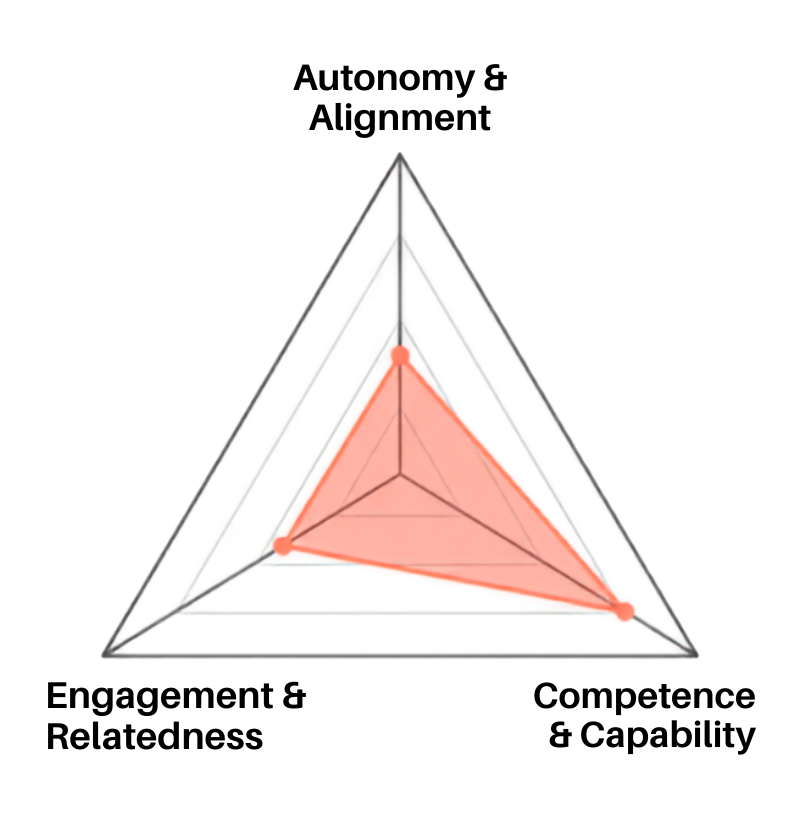
Intrinsic motivation is the most important determinant of performance, and it can be nurtured or destroyed by workplace practices. The components of intrinsic motivation that must be nurtured to drive peak performance are autonomy, competence, and relatedness. Before assessing an individual’s performance, you must first assess the environment that is producing that performance.
-
Environment Building and Monitoring
Ongoing clarification of expectations aligned to goals
Feedback on where they stand, and recognition of competencies
Coaching on how to do better
The What & The How: Assessing performance shouldn’t be a complex game using abstract numbers and labels; it's simply tracking what people achieve and how they behave, using plain language.
-
Replace painful annual review processes and implement simple, continuous conversation loops.
The High Performance Environment: Manager training, system design, and work processes make it easy to give people autonomy over how they reach goals, build their competence through continuous feedback and micro-recognition, and foster human connections that build relatedness.
Model-Agnostic Feedback Training that ensures managers have core soft skill capabilities
Templates, tools, and an accountability culture that enable feedback conversations that are frequent, seamless, and result in performance improvement.
Environmental Diagnostic using proprietary A.C.E. Framework: Managers and leadership teams regularly assess the environment using input from their teams, and then put plans in place to address the weakest areas.
Regular Streamlined Performance Assessments: Managers collect light, ongoing notes on the What (goals) and the How (core values/behaviors), then use AI tools to quickly summarize them when it's time for compensation or employment decisions (e.g., promotions, pay for performance). Defining the “How” may first require distillation of values/strategy into universal competencies.
Growth
How to support and develop your people without disrupting work
-
Employee career growth should fuel organizational performance, not distract from it. Development, mobility, and progression are key to healthy, adaptive companies and should be high ROI.
Learning is most effective when it's relevant, timely, repetitive, and experiential. Long-form annual training is good for knowledge transfer, inspiration, and condensed repetition, but to create new habits, it must be supplemented by experiences that occur in the course of work. Relevance and timeliness are rooted in personalization.
-
Employee Growth is Driven by Business Needs: This completes the thread from Impact profiles, goals, and expectations into long-term strategy, projected org design, and future skills.
Learning In-the-Flow of Work: Build growth directly into day-to-day work.
-
The Sweet Spot Career Dev Template: Align development goals at the exact intersection of what the company needs and what the employee actually wants. Traditional career development discussions start with employee interests and skills; ours start with what the business needs to thrive in the near future.
Behavioral Nudges: Critical information and recommended actions are delivered to specific people at specific times as they engage in specific tasks.
Learning Circles: Introduce lightweight, peer-led discussion groups built into existing team meetings to foster critical thinking and connection.
Micro-Mentorships: Short, focused pairings designed to help an employee clear a specific professional hurdle.
The Mid-Career Focus: If relevant, target mid-level professionals, the often-neglected backbone of the company, boosting retention and building an internal executive pipeline that saves the company executive search fees later on.
-
The three S’s:
Subject-Matter Expertise (SME)
Strategy
Speed
I solve all three.
Within these three categories, the needs look different for different types of companies.
For more mature companies
The SME gap is one of depth, rather than breadth. HR generalists are jacks-of-all-trades, and many orgs lack the internal expertise needed to accelerate progress in a particular area (like performance management).
Strategy is more about continuously manicuring a robust portfolio of activities to ensure each one is high-value, sunsetting the ones that aren’t, and developing new ones when necessary (an evidence-based “why” behind all actions, rather than primarily focusing on operations/execution).
Speed tends to be about removing unnecessary bureaucracy, adding more agility and experimentation, and opening up to lightweight high-ROI solutions instead of the comprehensive ones available that optimize for security and compliance rather than usability
For startups
SME involves thinking beyond hiring and embedding that thinking into the very top of the funnel, not as an afterthought.
Strategy needs to be laser-focused since they don’t have the luxury of a kitchen-sink approach; they must know exactly what to invest in and what not to.
Speed involves the lightest possible touch to fuel growth.
For non-profits
The range of SME needs to be vast to cover the variety of worker types and working environments.
The strategy needs to be airtight to justify funding of precious “overhead” costs.
And the speed needs to balance results with staying aligned to mission, culture, and the values/integrity that are the foundation of their work.
-
My primary measure of success will always be my client’s organization's success.
That is why we are working together.
However, sometimes bottom-line results take time to achieve, and large goals have important sub-goals. That is why I also use some leading metrics that are tailored to the specific solutions delivered.
Those leading metrics may not be the traditional ones you’re accustomed to, because those can oftentimes be mis-leading. That is because ideal outcomes vary by groups of people, and the most common metrics used are overall rates that miss that important nuance.
Let’s look at two common examples:
Hiring: Roles Filled ≠ Success
Filling Headcount is important, but for many compelling candidates, the ideal outcome is not to hire them. That is why I measure fit instead of roles filled.
Even then, hiring people is not the actual business purpose of hiring. You hire people to perform well at your company. That is why I also measure hiring success by looking at the performance of those hires in their first year at your company. Having an efficient pipeline that converts prospects to candidates to offer acceptances is great, but having a pipeline that pumps in only high-performers is even better.
Talent Management: Retention is Overused
Retention Rates are a good measure of success in keeping your highest performers and most critical talent.
However, retention is not the most important outcome, nor is it the ideal for everyone. For your big middle group of performers, development is likely more important, so you have the strongest possible core players who evolve with your business and serve as a pipeline into the top performer category. For your bottom group, movement is the most important metric. Folks who are underperforming should very quickly be moving up to the middle-performing category, around to a different role internally that is a better fit, or out to a different company or line of work.
FAQs
Let’s Work Together!
If you're interested in learning more, complete the form with a few details about your project. We'll review your message and get back to you within 48 hours.